For most businesses I speak with, an individual version or scenario of their plan isn't what is taking them to breaking point. One version of a bunch of spreadsheets can generally, sort of, hang together for quite a long while.
Where it falls over is when you need more than one version. As a result, when I speak with someone they're usually not doing much, if any, scenario planning - but they wish they were!
Which is why I am continually surprised by how little time they spend looking at how a new tool will do versioning better. It seems to be generally assumed that any tool can do scenarios; that's sort of true, but there is a tremendous range of capability out there.
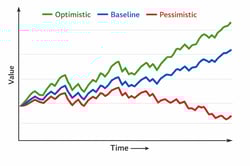
Having worked in this space a long time, I know a lot of the tricks a vendor might use in a demo (because, confession, I did them!). So when I looked at what tool Northexis would partner with, I asked for a specific demonstration - and you should too.
Note, for extra effectiveness, I strongly suggest you don't tell the vendor ahead of time. After all - this is basic stuff, and if they can't show it to you then and there, that should tell you a lot straight away.
Anyway, it is this:
1. Please create a new scenario called Optimistic Scenario, and copy the budget into it.
2. Change some numbers in two specific entities (or departments etc) in Optimistic Scenario (the two is important).
3. Then, build a new report from scratch which shows the variance between the two (you want it to show the different variances in the entities/departments/whatever the changes were made in).
4. You know what, I actually think the changes in Entity 1 are going to happen. Please copy Optimistic Scenario to the budget - only for Entity 1.
5. Show me the variance report again, showing the differences are now only in Entity 2.
All of that will take a good few minutes and won't be as slick and pretty as the rest of the demo, most likely, but it will be real. And each of the steps is important:
1. You must see this happening live to understand how easy it is to use - both creation and copy. We also want to understand how long the process will take, but in fairness to vendors their demo probably has easily 20 or 30 times the content in them you ever will, so I think it's reasonable if they pick a decent subset.
2. It should be simple to use data entry facilities you have seen already on the new scenario, and it's important that you see what they might have to do to make that happen.
3. This is to ensure that the scenario appears throughout the system (which is not always the case, at least in a timely fashion). Technically, an existing report showing the variance would be ok for this purpose, but bad report building is also something that vendors are very good at glossing over, so you might as well check that while you're doing this.
4. This is critical. A surprising number of tools on the market simply cannot do this - it's wholesale copy or nothing. This is fundamentally at odds with how a business needs to scenario plan - you must be able to make changes to multiple scenarios, then pick and choose elements to adjust your baseline over time.
5. This is just checking that point 4 actually happened.
That ended up longer than I expected, but that in itself highlights why you need to spend time on it I think!


